
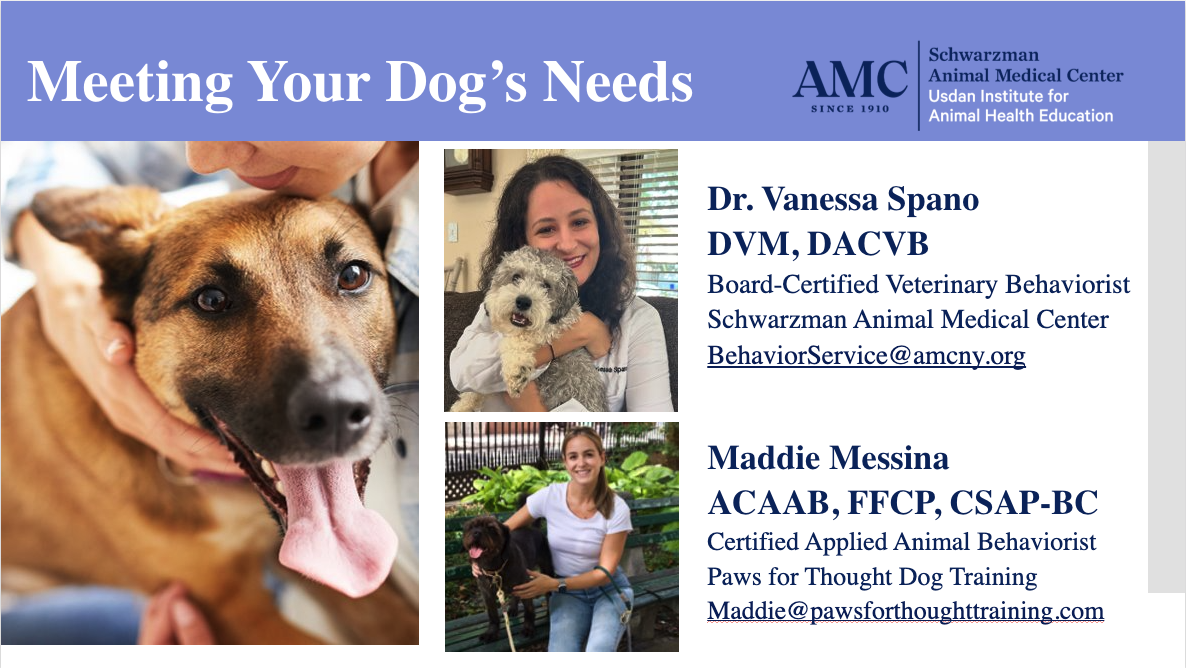
A few weeks ago, I had the pleasure of co-presenting a webinar with Dr. Vanessa Spano, DVM, DACVB, Board-Certified Veterinary Behaviorist at Schwarzman Animal Medical Center, called Meeting Your Dog's Needs. It was such a rich, wide-ranging conversation, and the questions that came in afterward told me there's a real appetite for this material — so I wanted to break it all down here.
You can watch the full recording here: Meeting Your Dog's Needs — Schwarzman AMC x Paws for Thought
But if you're more of a reader, grab a coffee and settle in. Because we covered a lot.
Why This Conversation Matters
Here's a statistic that I come back to again and again: in 2024, approximately 2 million pets were relinquished to shelters in the US. The number one reason cited? Behavior. What makes that especially heartbreaking is that research shows pets with behavioral issues are also at greater risk for abuse and neglect once they're in those situations.
One study found that 50% of pet owners reported behavior problems just one month after adoption and that those owners were significantly less likely to follow up with a veterinarian. So the ripple effects are real.
What Dr. Spano and I wanted to challenge in this webinar is the assumption that behavior problems are inevitable, or that dogs who struggle just need more discipline. Because in many cases, what looks like a "problem" is actually a dog whose needs physical, emotional, social simply aren't being met.

Problem Behavior, or Normal Dog Behavior?
Before we can talk about solutions, we have to ask an honest question: is this actually a problem, or is it behavior the dog was built to do?
Digging, chewing, barking, jumping, house-soiling, "excessive" energy, these are the behaviors that most often land dogs in shelters. They're also almost entirely normal, species-specific behaviors. The dog isn't broken. They're just a dog.
This is where Functional Behavior Assessments come in, something we use with every client. Instead of jumping straight to "how do I stop this," we ask two things:
What is the function of this behavior? Is it truly a problem, or just not aligned with what the guardian expected?
How can we adjust the environment or provide an appropriate outlet rather than just suppressing what the dog is trying to do?
Let's walk through the big ones.
Digging
Dogs dig to aerosolize scents, leave scent marks, investigate their surroundings, and thermoregulate. Terriers in particular were selectively bred for this — it's not a character flaw, it's centuries of genetics doing exactly what they were designed to do.
Rather than fighting it, some of my favorite strategies:
Designate a digging zone - a sandbox, a section of the yard, or a kiddie pool filled with water and interesting objects to sniff through
Bury treats or puzzle feeders in that designated spot to make it the most exciting place to dig
Explore Earth Dog trials or lure coursing for dogs who really need an outlet for this drive
Teach digging on cue. I know that sounds counterintuitive, but putting a behavior on cue actually gives you more control — and it opens up some genuinely useful applications, like a scratchboard for filing nails or pointing your dog to a specific spot in the garden.
Chewing, Mouthing, and Licking
Chewing serves a lot of purposes: food acquisition, dental health, self-soothing, and scent gathering (dogs have scent receptors in their mouths). Herding breeds are genetically predisposed to nipping. Puppies mouth and play-bite because that's developmentally normal.
And here's something I find genuinely exciting from the research: a 2025 study published in Frontiers in Veterinary Science found that chewing supports decompression after stressful experiences and helps dogs manage arousal. So offering a frozen Kong or a lick mat after something challenging - a vet visit, a loud thunderstorm, a walk that had a lot of triggers - isn't just a distraction. It's genuinely therapeutic.
Some of my go-to outlets:
Frozen Kongs and Lick Mats (especially post-stress)
Bully sticks
Flirt poles for dogs with a strong prey drive or herding instinct
"High Energy"
Working dogs, sporting dogs, herding dogs; these breeds were developed to run, problem-solve, and work alongside humans for long stretches. Putting a Border Collie or an Australian Shepherd in a city apartment and expecting them to self-regulate is a setup for everyone to be frustrated.
But here's what a lot of people don't realize: mental stimulation can be just as tiring as physical exercise.
Some of my favorites:
Scent work and nose work (this is genuinely one of the most mentally exhausting things you can ask a dog to do, in the best way)
Nina Ottosson puzzles and snuffle mats
Structured training classes like tricks, agility, obedience, scent work
That last one deserves its own mention. Training classes don't just teach skills. They build resilience through shaping, improve communication between you and your dog, and give high-drive dogs an outlet for their energy.
One important caveat: if your high-energy dog also has fear or reactivity outdoors, getting aerobic exercise in an environment that stresses them out can actually make things worse. The goal is exercise in conditions that feel safe and this may be worth thinking through with a professional.
Managing Arousal
This connects to something Dr. Spano and I talked about at length: the Yerkes-Dodson curve. Performance and learning are best at an optimal level of arousal, too low and the dog is disengaged, too high and they're over threshold and unable to take in new information. A lot of what we're doing with enrichment, training, and management is helping dogs find and maintain that middle zone.
Practically speaking, this means:
Meeting energetic needs before asking for calm behavior
Teaching and reinforcing relaxation from an early age (mat relaxation is one of my favorite exercises for this— we showed a demo in the webinar)
Working on "settle" training away from you, so your dog learns to self-regulate independently
Prioritizing clear communication, a dog who understands what you're asking is a less frustrated dog

Separation and Confinement Anxiety
If your dog is vocalizing, destroying things, or having accidents only when left alone: get a camera before you do anything else. What you're observing (or what your neighbors are reporting) could be separation anxiety, confinement distress, or something else entirely, and the approach differs significantly depending on what's actually happening.
Some foundational strategies:
Designate a safe zone and reward your dog for going there while you're home, not just at departure
Practice gradual departures, starting with just a few seconds
Provide a high-value food toy at the moment you leave
No punishment! A dog with separation anxiety is in a state of panic. Punishing them for the aftermath makes the underlying anxiety worse
Whether or not crate training is appropriate depends on whether the anxiety is separation-based or confinement-based another reason that camera footage is so valuable before starting any intervention.
Aggression: Why Avoiding Triggers Is the Right Call
One of the things I feel most strongly about and that Dr. Spano backed up beautifully from a neurological standpoint is that exposure therapy when a dog is fearful or aggressive is not a learning opportunity. It's called flooding.
Every time a dog practices a fear or aggression response, those neural connections get stronger. Every time we prevent that rehearsal, those pathways weaken. That's why I ask clients to cross the street, turn around, or manage their dog's environment proactively not to avoid the problem forever, but to stop reinforcing the wrong pattern while we systematically build the right one.
Dr. Spano introduced her Ladder of Canine Fear-Aggression in the webinar, and I cannot recommend it enough as a tool for dog owners. By the time a dog is growling, lunging, or biting, they've already been communicating distress for a while. Learning to read the early signs like yawning, lip licking, looking away, whale eye (seeing the whites of the eyes), paw lift, tucked tail means you can intervene and remove your dog from the situation before things escalate.
And if your dog is growling: please don't punish the growl. Growling is communication. Suppressing it doesn't remove the fear, it removes the warning sign.
Socialization: Starting Right, and Adjusting for Adult Dogs
The critical socialization window for puppies is 3–14 weeks of age. What happens during this period shapes how a dog perceives the world as an adult. But socialization isn't just exposure, its pairing new things with things the puppy already loves (treats, play, calm reassurance) so the associations become positive.
Safe options for young puppies who aren't yet fully vaccinated include clean streets for short periods, using a stroller to observe the environment, and supervised puppy playtimes in controlled settings. Research actually shows these are safe with appropriate protocols.
For adult dogs especially those adopted from other states or countries, who may have had very different early environments the approach shifts:
Pace everything slower
Positive reinforcement becomes even more important
Flooding (forcing exposure) is always off the table
Remember that dog sociability is a spectrum, not every dog needs or wants a dog park best friend, and that's completely okay
For adult dogs working on socialization, I love exercises like scent work, mat relaxation, and cooperative care handling all of which build confidence and trust without direct social pressure.

How Dogs Learn
Understanding learning theory isn't just for trainers. It genuinely changes how you see your dog's behavior. Dogs learn through two main mechanisms:
Operant conditioning — the consequences of their behavior. Behaviors that are reinforced (rewarded) increase. Behaviors that aren't reinforced, decrease. This is the foundation of reward-based training, and the research consistently supports it as the most effective and least harmful approach.
Classical conditioning — the emotional associations they form. This is why putting on your shoes predicts a walk, and why a trigger that was once scary continues to predict fear. Counter-conditioning — systematically pairing that trigger with something wonderful, at a distance the dog can handle — is how we change those associations over time.
The research on punishment-based methods is clear: they're associated with increased fear, anxiety, and aggression. Not because dogs need to be coddled, but because pain and intimidation suppress behavior without teaching anything — and they erode trust. This includes prong collars, shock collars, choke chains, and citronella sprays. None of them belong in a modern, evidence-based training toolkit.
How to Choose the Right Trainer
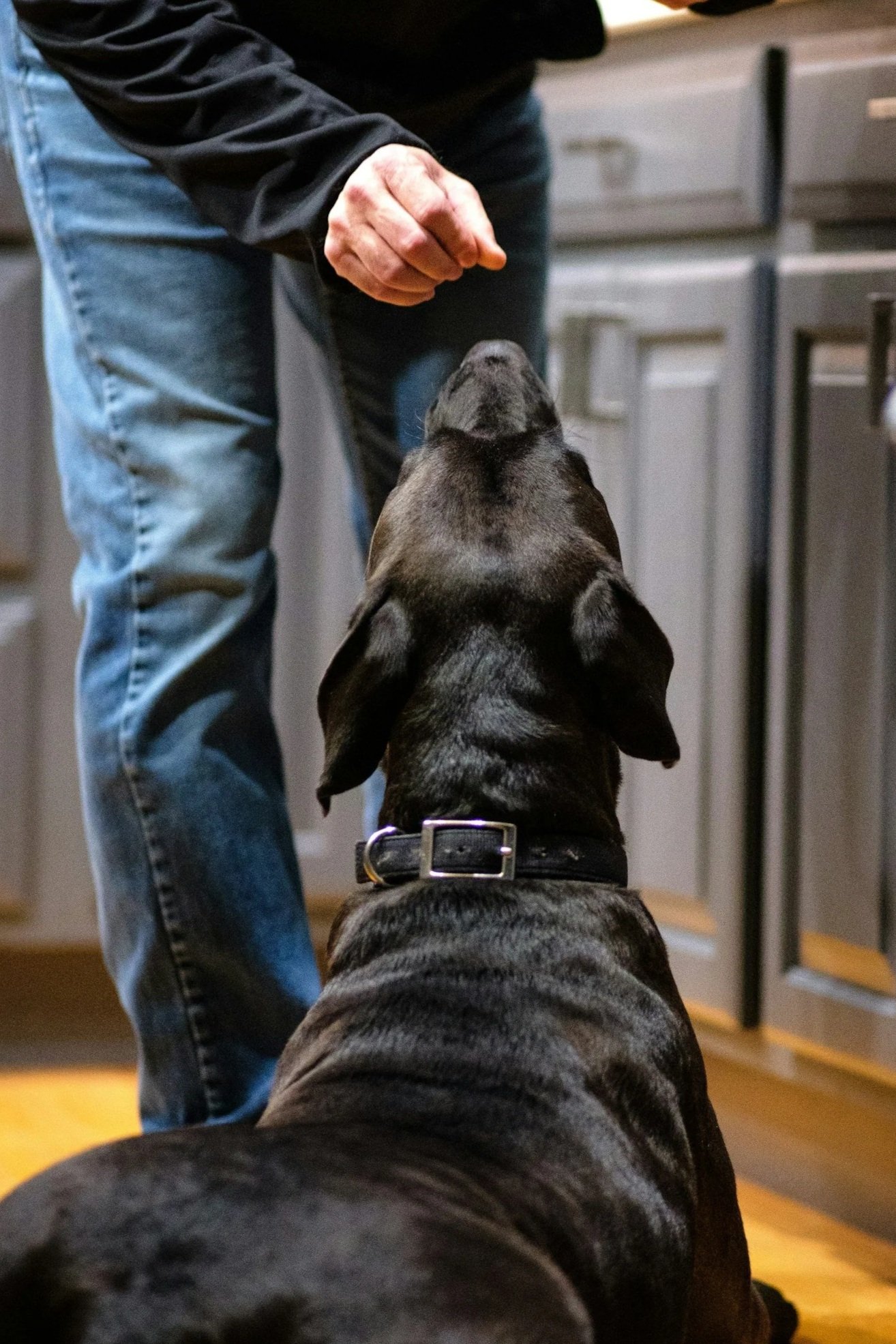
Since we're on the subject: if you're looking for professional support, here's what to look for:
Humane, evidence-based, reward-based methods
Educated in learning theory, behavioral psychology, and applied behavior analysis
Responds appropriately to even subtle signs of stress in the dog not just the obvious ones
No flooding, no punishment-based tools, no "balanced training," no dominance/alpha vocabulary
Credentials that signal solid professional training: CPDT-KA, KPA, CDBC or CCBC (through IAABC), CAAB or ACAAB, FFCP.
I'm so grateful to Dr. Spano and the Schwarzman Animal Medical Center for putting this together with us — it's exactly the kind of conversation I wish every dog owner could have before behavior challenges escalate to the point of crisis. If you missed the live session, you can watch the full recording here.
And if anything in this post resonates with what you're experiencing with your own dog, please don't hesitate to reach out. That's what we're here for.
References:
Quinn, R., Masters, S., Starling, M., et al. (2025). Functional significance and welfare implications of chewing in dogs (Canis familiaris). Frontiers in Veterinary Science, 12. https://doi.org/10.3389/fvets.2025.1499933
Gazzano, A., Mariti, C., Alvares, S., et al. (2008). The prevention of undesirable behaviors in dogs: effectiveness of veterinary behaviorists' advice given to puppy owners. JVB, 3, 125–133.
Lord, L.K., Reider, L., Herron, M.E., et al. (2008). Health and behavior problems in dogs and cats one week and one month after adoption from animal shelters. JAVMA, 233, 1715–1722.
Stepita, M.E., Bain, M.J., and Kass, P.H. (2013). Frequency of CPV infection in vaccinated puppies that attended puppy socialization classes. JAAHA, 49(2), 95–100.